
Miami Family Court Case Records Access
Miami family court records are maintained by the Miami-Dade County Clerk of Court. The city clerk does not handle court files. All divorce, custody, and support cases for Miami residents go through the county system. The 11th Judicial Circuit Court serves the Miami area. Family law matters are filed at the county level. Understanding this distinction helps you find the right office.
Miami Quick Facts
Miami-Dade County Clerk Maintains Miami Family Court Records
Family court records for Miami are maintained by the Miami-Dade County Clerk of Court, not the Miami City Clerk. Juan Fernandez-Barquin serves as the elected clerk, and his office manages all court records for the 11th Judicial Circuit, which includes cases from Miami and over 30 other municipalities throughout Miami-Dade County. This centralized record-keeping system ensures that all family law documentation is housed in one location, but it also means that Miami residents must visit county offices rather than city offices to access divorce filings, custody orders, or support documentation.
The county clerk's main office is located at 73 W. Flagler Street in downtown Miami, serving as the primary repository for family court records. This location houses the official documentation for thousands of active and closed family law cases filed by Miami residents. Staff members are available to assist with case searches using party names or specific case numbers, and they provide certified copies for legal proceedings. The office operates Monday through Friday from 8:00 AM to 4:00 PM, and visitors should bring valid photo identification and be prepared for security screening.
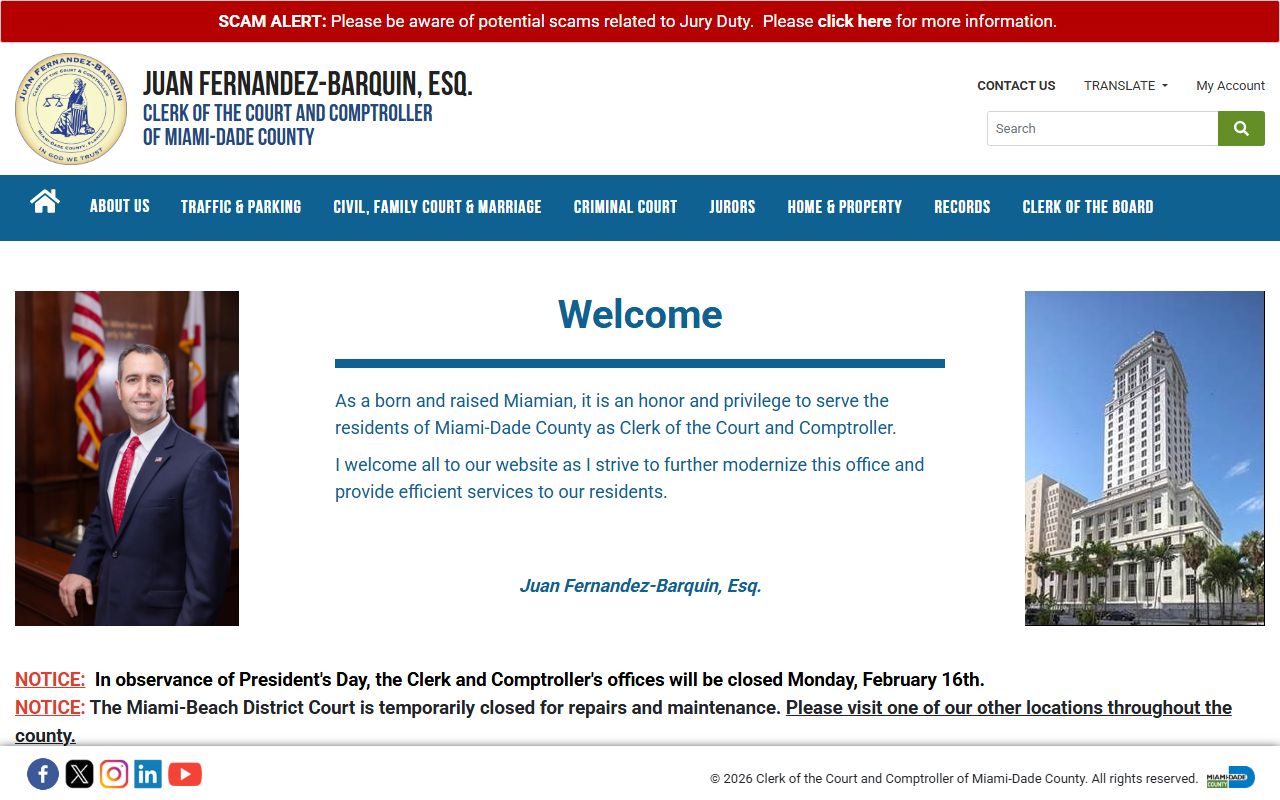
The Miami-Dade County Clerk office maintains all family court records for Miami residents.
| Office | Miami-Dade County Clerk of Court |
|---|---|
| Clerk Name | Juan Fernandez-Barquin |
| Address | 73 W. Flagler Street, Miami, FL 33130 |
| Phone | (305) 275-1155 |
| Website | www.miamidadeclerk.gov |
The Miami City Clerk's office is located at 3500 Pan American Drive near Dinner Key Marina and can be reached at (305) 416-2010. This office maintains city commission records, municipal contracts, and local permits, but they do not possess any court files or family law documentation. Miami residents seeking divorce records, custody orders, or any family court documentation must contact the Miami-Dade County Clerk directly, as city offices have no access to judicial records.
Online Access to Miami Family Court Records
You can search Miami family court records remotely through several online platforms provided by the Miami-Dade County Clerk. The official website at www.miamidadeclerk.gov features a comprehensive case search tool that allows you to look up family law matters by party name or case number. This system provides access to case history, docket entries, and some downloadable documents, making it a convenient starting point for residents who need to verify case status or review basic information without visiting the courthouse.
The Online Court System (OCS) at www2.miamidadeclerk.gov/ocs offers more detailed case access, displaying comprehensive case histories and docket entries that show the progression of family law matters through the court system. For statewide searching that includes Miami cases, the Florida E-Filing Portal at www.myflcourtaccess.com covers all 67 Florida counties and is particularly useful when you need to search across multiple jurisdictions. While online systems provide substantial case information, full document access may require an in-person visit, and certified copies must be obtained directly from the clerk's office at the courthouse.
Types of Family Court Records in Miami
Miami family courts within the 11th Judicial Circuit handle a comprehensive range of case types, each generating detailed records that the public can access through the Miami-Dade County Clerk. Divorce cases constitute the most frequent filings, creating extensive documentation that includes initial petitions, financial affidavits detailing marital assets, settlement agreements addressing property division and alimony, and final judgments of dissolution. Child custody proceedings produce parenting plans that establish time-sharing schedules, define parental decision-making authority, and outline visitation arrangements. Child support records contain payment orders based on Florida's income shares model, along with modification requests and enforcement actions.
Domestic violence cases move through Miami's family court system with expedited processing, as temporary injunctions can be granted within hours to protect victims from immediate harm. Paternity actions establish legal parentage and associated rights and responsibilities, while adoption proceedings create permanent records of new family relationships. Guardianship cases are also maintained for individuals appointed to care for minors or incapacitated adults.
Miami family law cases create detailed records that are maintained by the county clerk.
The majority of family court records in Miami are public documents accessible to any interested party, though certain sensitive information receives protection under Florida law. Social security numbers, bank account information, and residential addresses in domestic violence cases are automatically redacted. Some files may be sealed by court order when privacy interests outweigh public access rights.
Miami Family Court E-Filing Portal
Miami residents can file family court cases electronically through the Florida E-Filing Portal, a system that has transformed how legal documents are submitted to the courts. This digital platform allows attorneys and self-represented parties to submit petitions, motions, and other case documentation from any computer with internet access, eliminating the need to travel to the courthouse for routine filings. The portal accepts various document formats with PDF being the standard, and it provides confirmation receipts for every submission to create a record of what was filed and when.
To utilize the e-filing system, you must first create an account on the portal website and complete the registration process. Once registered, you can initiate new family law cases or add documents to existing cases by following the step-by-step submission procedures. The system guides users through document classification, party identification, and filing fee payment. While e-filing is mandatory for attorneys practicing in Miami-Dade County, it remains optional for self-represented litigants who may still file paper documents in person if they prefer traditional methods.
Miami City Clerk vs County Clerk
Miami operates two distinct clerk offices with fundamentally different responsibilities, and knowing which one to contact will save you considerable time and frustration. The Miami City Clerk serves the municipal government and handles administrative records related to city operations, while the Miami-Dade County Clerk serves the judicial system and maintains all court-related documentation. This distinction is particularly important for family law matters because the city clerk has no access to court records, regardless of where the case was filed or whether the parties reside within Miami city limits.
The City of Miami Clerk is located on Pan American Drive near Dinner Key Marina and maintains city commission minutes, municipal contracts, business permits, and various local government records. They do not possess family court files, divorce records, or any documentation related to judicial proceedings. The Miami-Dade County Clerk is located on Flagler Street in downtown Miami and serves as the official custodian of all court records for the 11th Judicial Circuit. This office handles every family law case filed by Miami residents, including divorce, custody, support orders, and domestic violence injunctions.
Both offices require photo identification for record requests and services. The courthouse location has mandatory security screening, so plan to arrive early to allow sufficient time for this process. Parking garages and public transit options are available near both locations, and planning your route in advance will help ensure a smooth visit to the correct office.
Miami-Dade County Family Court Records
As the largest city in Miami-Dade County and a major metropolitan hub for South Florida, Miami's family court records are fully integrated into the Miami-Dade County court system. The Miami-Dade County Clerk maintains comprehensive family law files for Miami residents as well as residents of over 30 other municipalities throughout the county, including Hialeah, Miami Beach, Homestead, Coral Gables, and many smaller communities. Understanding this county-level record maintenance system is essential for anyone seeking access to family court documentation in the Miami area.